
AR

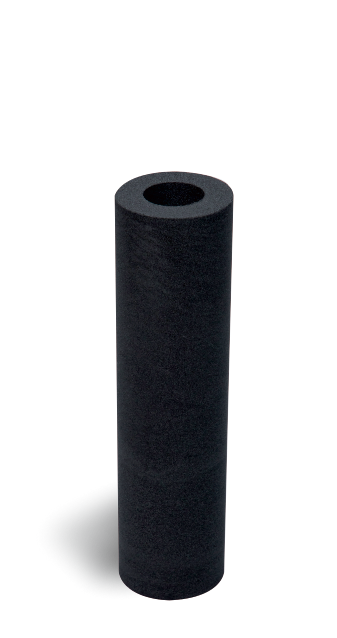
The Thesvin Ф32×106 sintered activated carbon rod is a cylindrical filter element that drops into the housing of household water purifiers, refrigerators with built-in water dispensers, and shower filters, where it adsorbs chlorine, odours and colour while softening water and reducing heavy metals such as lead and mercury. It is made from high-iodine coconut shell carbon and food-grade ion exchange resin, sintered into a rigid block that will not release black powder downstream. This page is written for engineers and buyers who need to confirm fit before performance: where the rod seats, how the end faces locate, and how the Ф32 mm outside diameter and 106 mm length match the cavity.
Fit is decided by three dimensions: the outside diameter that enters the housing bore, the length that sets the compression against the end seals, and the squareness of the end faces that carry the sealing load. The Ф32×106 rod is one of the standard sizes in the Thesvin range, and it is built to hold its shape under the axial load applied by the housing cap. Because the block is sintered rather than wound, the outside diameter stays stable in service, so the radial clearance to the housing wall does not open up over time.
The block can be supplied with end caps welded to the rod so that the customer's housing seal seats on a defined face rather than on cut carbon. For equipment where the original filter is not a straight cylinder, Thesvin builds tooling to match the inner and outer diameter ratio, the end profile and the cap interface. The practical rule is simple: send the housing drawing or the old part, and fit will be confirmed against the cavity dimensions before a sample is made.
The carbon is a high-iodine coconut shell grade chosen for a large adsorption capacity and a uniform micropore structure. In service it removes free chlorine and the associated bleaching-powder taste, colour bodies and a range of organic compounds, and it traps fine particulate because the sintered wall acts as a depth filter. The ion exchange resin blended into the matrix softens the water and reduces scale formation on downstream membranes and heating elements, and it contributes to the reduction of lead and mercury. The initial pressure drop is low because the pore structure is open and even, which matters on purifiers with small pumps and on refrigerator circuits that run at low line pressure.
This rod is typically used as a CTO pre-filter or a T33 post-filter in domestic reverse-osmosis purifiers, as the cartridge in point-of-use drinking-water machines, in side-by-side refrigerators with an internal water tank, and as a pre-filter ahead of commercial coffee machines. It is not intended for hot water above the housing rating or for water carrying high sediment loads without a preceding sediment stage.
| Item | Detail |
|---|---|
| Product name | Thesvin sintered activated carbon rod filter (carbon block / CTO filter) for water purifiers and refrigerators |
| Core filtration materials | High-iodine coconut shell activated carbon and food-grade ion exchange resin |
| Core performance | Softens water and limits scaling, adsorbs free chlorine strongly, removes off-colour and off-odour, reduces harmful heavy metals including lead and mercury |
| Precision and service life | Uniform micropore structure, high initial flow, high filtration precision, no black powder release; large saturated adsorption capacity and long service life |
| Standard size reference (outside diameter × length, mm) | Ф60×130 / Ф62×240 / Ф37.5×75 / Ф38×57 / Ф40×195 / Ф51×127 / Ф32×126 / Ф32×106 |
| Main end applications | Domestic reverse-osmosis purifiers (CTO pre-filter / T33 post-filter), point-of-use drinking-water machines, built-in refrigerator water filters, commercial coffee machines |
| Customisation service | Full OEM/ODM support; length, diameter and inner/outer diameter ratio can be tooled to the equipment, with optional end-cap welding |
| Quality system | ISO 9001 and IATF 16949 certified production; filter media meet drinking-water safety and hygiene standards; in-house CNAS-accredited laboratory for product control |
Dimensional consistency is controlled from incoming material to final packing. Incoming coconut shell carbon and resin are inspected at IQC, the sintering and machining steps are monitored by IPQC, and finished rods are checked at OQC against the approved drawing. The plant operates under IATF 16949, issued in 2024, and under ISO 9001, ISO 14001 and ISO 45001, so the same process control applies to a water filter as to a filtration part for a vehicle programme. The in-house laboratory holds CNAS accreditation and issues reports on filtration efficiency, dust holding and resistance, which buyers can use in their own qualification files. Manufacturing runs on a 50,000 m² site in Zhongshan, Guangdong, China, where the clean workshops support the hygiene requirements of drinking-water products.
To move from this page to a quotation, send the device or vehicle model, the filter size or a drawing, the required water flow, the operating conditions (pressure, temperature, inlet water quality) and the quantity you expect per order and per year. If no drawing exists, ship an old part and Thesvin will measure it. Start here: contact our team.
Fit depends on the housing bore, the cavity depth and the seal face, not on the model name alone. The Ф32×106 rod is a standard Thesvin size, so if your housing accepts a 32 mm outside diameter and a 106 mm length, it is a direct candidate. Send the housing drawing or an old filter and the fit will be confirmed before you order.
Yes. An old filter is often the fastest way to define the interface, because it carries the true outside diameter, length and end profile. Thesvin measures the part and matches the new rod to it, including any end-cap interface. Where the old part is deformed, the housing drawing is requested as well.
The high-iodine coconut shell carbon removes free chlorine, off-odours, colour and organic compounds, while the food-grade ion exchange resin softens the water and reduces lead and mercury. The sintered structure gives a high initial flow and a high filtration precision without releasing black powder. Performance reports on filtration efficiency and resistance are issued by the in-house CNAS-accredited laboratory.
Yes. Thesvin supports OEM and ODM work on length, diameter and the inner/outer diameter ratio, and can weld end caps to suit the housing seal. The standard range already covers sizes from Ф32×106 to Ф62×240, and a new size is tooled from the equipment drawing. Tooling and sample timing are confirmed after the drawing review.
Minimum order quantity, sample policy and price are set per specification, so they are confirmed with the quotation rather than published as a single figure. Send the model, size or drawing, flow rate, operating conditions and expected quantity through the contact page, and the sales team will reply with sample and order terms. Samples are built to the agreed drawing so the test matches production.
Lead time depends on whether the size is standard or requires new tooling, and on the order quantity. The production schedule is set at quotation stage once the drawing and quantity are fixed. For repeat programmes, delivery can be phased to match your line requirements.
Replacement interval depends on inlet water quality and daily water consumption, and is set by the appliance maker or by monitoring downstream chlorine breakthrough. The rod is designed with a large saturated adsorption capacity for a long service life, but no single interval applies to every installation. Use the pressure drop and water taste as early indicators.
It is used as a CTO pre-filter or T33 post-filter in domestic reverse-osmosis purifiers, in point-of-use drinking-water machines, in refrigerators with built-in water filters and as a pre-filter for commercial coffee machines. It suits cold-water circuits within the housing rating. For high-sediment water, a sediment stage is recommended ahead of the carbon rod. To check your application, send the details through the contact page.