
AR

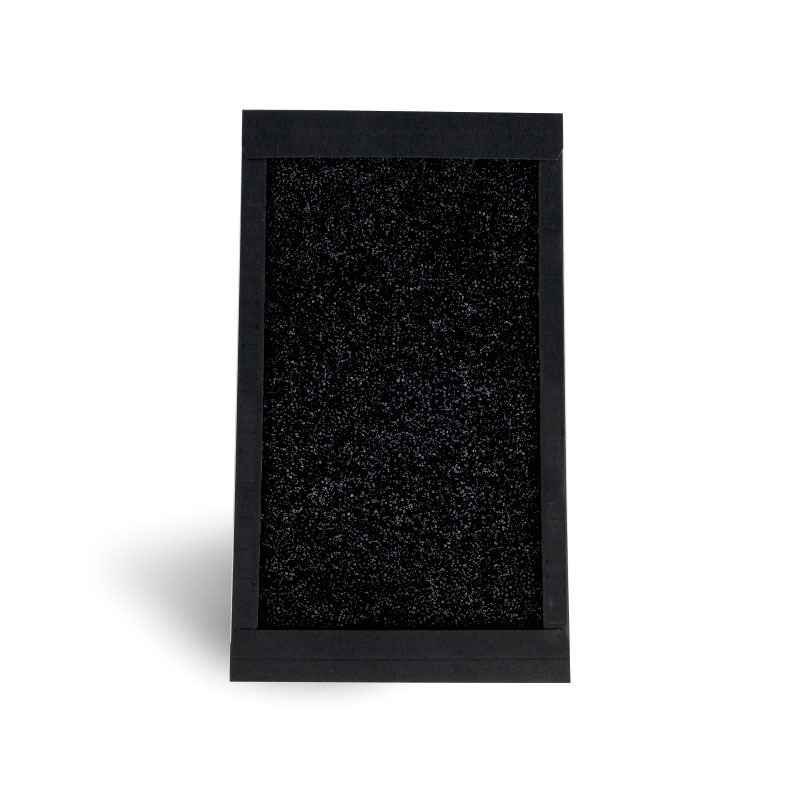
Thesvin fresh air and fresh air conditioner odor removal filters are composite filters that combine PP media with modified activated carbon for particle and odor control in fresh air systems and fresh air air conditioners. The filter traps fine particulate matter such as PM2.5 and pollen while the high-iodine-value activated carbon layer adsorbs formaldehyde, TVOC and other odors. It is made for appliance makers and HVAC equipment manufacturers who need a filter that fits their unit's frame and airflow path. Every filter is built to the customer's unit requirements, from flat panels to V-shaped folded and composite constructions.
Fitment comes first in a fresh air filter. The filter is not a universal part; it is a component that must sit in a specific frame, seal against the housing, and leave the airflow path unobstructed. Thesvin builds the filter to the host unit's drawing, so the outer dimensions, frame and folded structure match the slot the unit provides. Flat panel, V-shaped folded and composite formats are all available, which lets one filter program cover wall-mounted fresh air machines, cabinet fresh air air conditioners and central fresh air HVAC systems.
How the filter seals and locates follows the unit's mechanical interface. Because each filter is tooled and cut to the customer's approved drawing, the frame and dimensions are matched to the host device or duct rather than trimmed in the field. The composite PP media plus activated carbon construction keeps both the dust and odor functions in one replaceable element, so the unit's filter slot only has to accommodate a single part. Where a system uses a V-shaped folded element, the fold geometry is set by the unit's airflow direction and pressure path, and the part is made to the drawing the customer confirms.
The media is composite PP filter paper with modified odor-removal activated carbon. The PP layer handles fine particles, including PM2.5 and pollen, at filtration levels covering F7, F8 and F9 (medium efficiency) through H11, H12 and H13 (HEPA). The activated carbon layer targets gases and odors, adsorbing formaldehyde, TVOC and similar odor-causing compounds. The result is a single filter that performs particle removal and odor removal together, which suits fresh air systems where outdoor air is brought in and both dust and odors must be addressed.
Typical applications are household wall-mounted fresh air machines, cabinet-style fresh air air conditioners, and household and commercial central fresh air systems. The filter is also relevant to fresh air system odor removal, fresh air air conditioner high-efficiency filtration, and HEPA composite filter elements for fresh air machines. The carbon layer is described as high-iodine-value activated carbon, intended for deeper adsorption of formaldehyde and odors.
| Item | Detail |
|---|---|
| Product name | Fresh Air System / Air Conditioner Filter |
| Core filtration media | Composite PP (polypropylene) filter paper plus modified odor-removal activated carbon |
| Particle filtration efficiency | Covers F7 / F8 / F9 (medium efficiency) through H11 / H12 / H13 (HEPA) |
| Core performance | Two functions in one: removal of fine particulate matter (PM2.5, pollen) plus deep adsorption of formaldehyde, TVOC and other odors |
| Product application categories | Fresh air system odor removal filter; fresh air air conditioner high-efficiency filter; fresh air machine HEPA composite filter element |
| Main application scenarios | Household wall-mounted fresh air machines, cabinet-style fresh air air conditioners, household and commercial central fresh air systems (HVAC) |
| Specification and dimension customisation | Tooled and built entirely to the customer's unit requirements; supports flat panel, V-shaped folded and composite custom formats |
| Quality and certification assurance | Air resistance and purification efficiency tested before shipment; production follows the ISO 9001 quality management system and IATF 16949 certification; materials are environmentally safe |
Dimensional consistency is the core of a filter that has to fit. Thesvin's production is certified to IATF 16949, obtained in 2024, and applies IQC, IPQC and OQC controls across the process: incoming material inspection, in-process inspection, and outgoing inspection. That flow is what keeps frame dimensions and media build consistent from one batch to the next, which matters when filters are installed on an assembly line or replaced in the field.
The company's in-house laboratory is CNAS-accredited and can issue test reports for filtration efficiency, dust holding capacity and resistance. The manufacturing base covers 50,000 m², including 6 clean workshops totalling 20,000 m². The company holds ISO 9001, ISO 14001 and ISO 45001 system certifications, and products meet REACH and RoHS environmental requirements with compliance documents available. Filters are tested for air resistance and purification efficiency before shipment.
To quote accurately, Thesvin needs the device or vehicle model, the filter size or a drawing, the airflow or water flow the unit handles, the operating conditions, and the quantity you expect to order. Send these details through the contact page and the team will confirm the media grade, format and tooling route for your unit.
Thesvin builds each fresh air and fresh air air conditioner filter to the customer's unit requirements, so fitment is set by the drawing rather than by a generic size. Flat panel, V-shaped folded and composite formats are supported, and the frame and dimensions are matched to the host device or duct. Send the unit model and filter slot dimensions or a drawing to confirm the fit.
Yes. An old filter sample can serve as the starting point when a dimensioned drawing is not available, together with the unit model if possible. Thesvin then confirms the dimensions and structure against the sample before tooling and sampling. Clear fitment information shortens the time to an approved first article.
The composite PP media covers F7, F8 and F9 medium-efficiency levels through H11, H12 and H13 HEPA levels. The activated carbon layer adds adsorption of formaldehyde, TVOC and other odors so particle and odor removal happen in one element. The exact grade is selected with the unit's performance requirements.
Yes. Specifications and dimensions are tooled entirely to the customer's unit requirements, including flat panel, V-shaped folded and composite formats. The particle filtration level and the activated carbon layer are specified together with the format. This supports appliance makers and HVAC equipment manufacturers with their own housing designs.
Thesvin supports sample evaluation before a volume order, and sample arrangements are discussed with the inquiry. Lead time depends on the format, media grade and whether new tooling is needed, and is confirmed at quotation. Provide quantity and target schedule through the contact page for an exact response.
Replacement depends on local air quality, daily running hours and pollutant concentration, so Thesvin sets the recommendation for each filter program from the unit and application data. Replace when the unit's airflow or odor performance indicates loading, or on the schedule agreed for the specific build. The product data does not state a single interval that applies to all installations.
Production is certified to IATF 16949 and applies IQC, IPQC and OQC controls for dimensional consistency. Filters are tested for air resistance and purification efficiency before shipment, and the CNAS-accredited in-house laboratory can issue reports for filtration efficiency, dust holding capacity and resistance. Materials meet REACH and RoHS requirements with compliance documents available.
Send the device or vehicle model, the size or a drawing, the airflow or water flow, the operating conditions and the expected quantity through the <a href="/en/contact">contact page</a>. Thesvin will then confirm the media grade, format and tooling route and return a quotation.