
AR

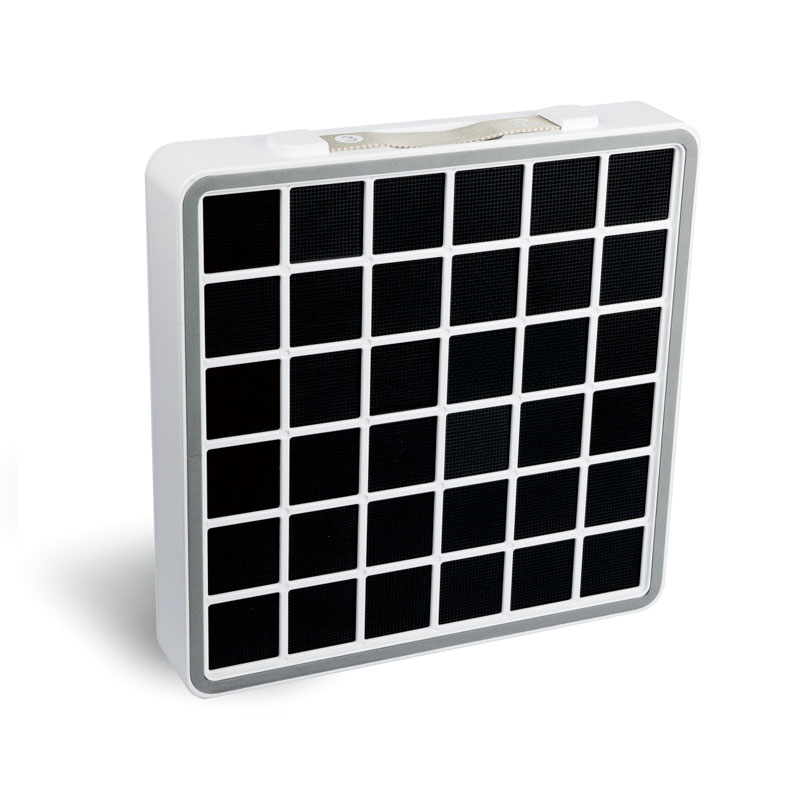
The Thesvin honeycomb activated carbon filter is a plate-style gas-phase filter built on a high-strength, moisture-resistant plastic honeycomb frame filled with high-iodine-value granular activated carbon or catalyst-modified carbon. It is designed to adsorb formaldehyde (HCHO), benzene, ammonia, TVOCs and stubborn odours in household and commercial air purifiers, fresh-air ventilation systems, vehicle HVAC systems and central air-handling return-air odour-control sections. Fitment engineers choose it when a low-profile, low-pressure-drop carbon stage must drop into an existing tray or duct opening without reworking the host device.
Fitment starts with the frame. Thesvin uses a high-strength, moisture-resistant engineering plastic honeycomb as the structural body, so the panel holds its shape across humid operating cycles and resists collapse when the host fan pulls air through it. The open-cell geometry gives a very high porosity, which keeps the filter thin while allowing air to pass in a straight, unobstructed path. For the installer, that means the panel seats flush in a flat tray or a return-air slot and does not need extra depth behind the grille.
Because the honeycomb core is rigid, the outer dimensions locate the part: length, width and thickness define how it sits in the host device, and the frame edge is what the retaining feature bears against. Thesvin manufactures to the drawing, so the outer profile, the honeycomb cell size and the carbon loading weight are all specified by the customer rather than fixed by a catalogue. This is the practical difference between a cut-to-size carbon pad that sags into the airflow and a moulded honeycomb panel that stays flat for the service interval. If you are replacing an existing carbon stage, the old part's outer dimensions are usually the fastest route to a matching fit.
The filter targets gas-phase contaminants rather than particulate. High-iodine-value granular activated carbon, or a combination of carbon with catalyst-modified formaldehyde-removal granules, adsorbs formaldehyde, benzene, ammonia, TVOC and common household and vehicle odours. In air purifiers it is typically the second or third stage behind a particulate filter; in fresh-air systems it protects occupants from outdoor traffic and industrial odours; in vehicle HVAC it reduces cabin smells and VOC ingress; in central air-handling units it is used in return-air odour-control sections.
The honeycomb structure contributes to performance as much as the carbon does. A very high porosity means a large carbon surface is exposed to the airstream at low resistance, so the fan does not have to work harder to move the same volume of air. The plastic honeycomb also resists moisture and mould and is corrosion-resistant, which matters in humid climates and in vehicle applications where the filter sees repeated condensation cycles.
| Item | Detail |
|---|---|
| Product name | Honeycomb activated carbon filter – plastic honeycomb type |
| Frame material | High-strength, moisture-resistant engineering plastic honeycomb framework |
| Core media | High-iodine-value granular activated carbon, or catalyst-modified formaldehyde-removal carbon granules |
| Target contaminants | Formaldehyde (HCHO), benzene, ammonia, TVOC and stubborn odours |
| Structural properties | Very high porosity, smooth airflow, very low operating resistance, moisture and mould resistant, corrosion resistant, does not collapse |
| Typical applications | Household and commercial air purifiers, fresh-air ventilation systems, vehicle HVAC filters, central air-handling return-air odour control |
| Customisation | 100% OEM customisation: outer length and width, thickness, honeycomb cell size and carbon loading weight can be tooled to drawing |
| Quality system | Manufactured in a 50,000 m² plant; ISO 9001, ISO 14001 and IATF 16949 certified |
Thesvin operates a 50,000 m² production site in Zhongshan, Guangdong, China, including six clean workshops totalling 20,000 m². Dimensional consistency is controlled through IQC, IPQC and OQC: incoming plastic honeycomb and carbon are inspected, in-process panels are checked during moulding and filling, and outgoing batches are inspected before packing. The company has held IATF 16949 automotive quality management certification since 2024 and also holds ISO 9001, ISO 14001 and ISO 45001.
The in-house laboratory is CNAS-accredited and can issue test reports covering filtration efficiency, dust holding capacity and resistance, which supports customer validation and market access. Products meet REACH and RoHS requirements and compliance documents can be supplied. With more than 20 years of filtration development and manufacturing experience and over 1,000 filtration solutions developed, Thesvin exports to Europe, the United States, Japan and Korea. Multiple automated production lines support monthly output in the millions of pieces. OEM and ODM options include size, structure, media grade, frame material, logo and packaging.
To get a fitment-checked quotation, send the device or vehicle model, the required size or a drawing, the airflow or water flow (as applicable), the operating conditions and the quantity. If a drawing is not available, an old part or a measured photo is enough to start. Contact Thesvin and include your target service interval so the carbon loading can be matched to it.
Fitment is determined by the outer length, width and thickness you specify, because Thesvin tools the plastic honeycomb frame to your drawing. Send the dimensions of the tray or duct opening, or the old filter, and the panel will be made to that interface. The rigid honeycomb body keeps its shape, so it seats flat without extra support.
Yes. An old filter or a photo with a ruler in frame is enough for Thesvin to establish the outer dimensions and thickness. The team can also work from a device or vehicle model if the original part is unavailable. A sample can then be produced for bench fitting before production.
Thesvin honeycomb activated carbon filters use high-iodine-value coconut-shell activated carbon formed into a honeycomb structure. Removal efficiency for common TVOC pollutants such as toluene, benzene and xylene can reach 85% or more. Actual performance depends on cell size, carbon loading and operating conditions, and can be confirmed by CNAS-accredited laboratory testing.
Yes. Thesvin supports full OEM and ODM customisation of size, thickness, honeycomb cell size, carbon type (coconut-shell, coal-based or modified), frame material (paper, plastic or aluminium), carbon content and functional combination such as HEPA plus carbon. Logo printing, custom packaging and retail colour-box design are also available.
Standard models typically have an MOQ of 1,000–2,000 pieces; custom models are quoted according to specification complexity, with flexible MOQ for long-term customers. Regular orders take 25–35 days, and repeat orders 15–20 days. Capacity from the 50,000 m² plant supports large-volume schedules.
In a standard household air-conditioning application running about 8 hours per day, the effective service life is 6–12 months. The actual interval depends on TVOC concentration, temperature, humidity and airflow. Thesvin's CNAS-accredited laboratory can provide life testing against your operating conditions to help set a replacement schedule.
Yes. Standard samples are dispatched within 3–5 working days; custom samples typically take 7–15 working days depending on design complexity. Samples are supplied with a CNAS laboratory test report, and for B2B customers with a clear intention to order, the sample cost can be credited against the formal order.
Standard packaging uses a moisture-barrier PE bag, corrugated carton and palletised container loading to prevent damp, deformation and crushing in transit. Neutral, branded or retail colour-box packaging can be specified. Export orders ship FOB Zhongshan, Shenzhen or Guangzhou, with sea, air and express logistics support.