
DE-DE

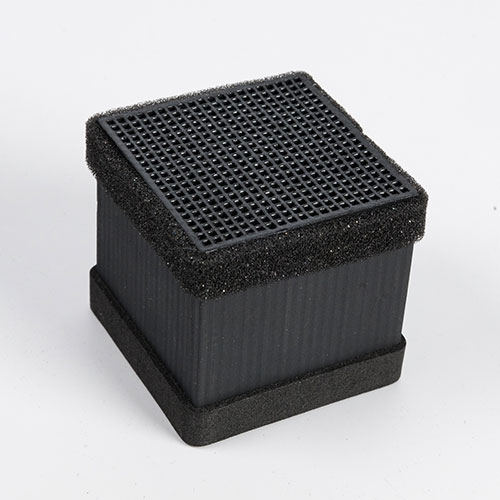
The Thesvin sintered activated carbon block filter is a high-temperature bonded filter element that removes ozone, VOCs, formaldehyde and odour molecules from air streams. It combines a dust-holding microfiber layer with a high-iodine coconut-shell carbon core, and is designed for printers and copiers, range hoods, integrated stoves, refrigerators and similar air-handling devices. It is aimed at OEM and ODM buyers who need a stable, low-resistance filter that fits a defined cavity and seals without shedding carbon dust.
The first thing to confirm with a sintered carbon block is not efficiency but fit. In most host devices the filter sits in a moulded pocket or behind a grille, and the air path is only as good as the interface: if the block is undersized, air bypasses it; if it is oversized, the housing distorts and the seal line opens. Thesvin builds each block to the drawing or sample supplied, so the outer dimensions, thickness and frame material are matched to the cavity rather than chosen from a catalogue. The one-piece sintered body holds its shape in service, which helps the block stay located against the housing face and keeps the airflow path predictable.
Because the carbon is fused rather than loosely packed, there is no granular movement inside the block. That matters where the filter is mounted vertically or where the device is moved: a loose fill can settle and leave a gap at the top of the frame, while a sintered block keeps a uniform carbon layer across the whole face. The anti-dust-shedding construction also protects nearby components such as print heads, fans and sensors from fine carbon particles. Frame material can be plastic, metal or paper, and the outline can be square, round or a custom shape, so the part can replace an existing cartridge without changing the host tooling.
The filter targets two families of contaminants. The microfiber layer captures dust and particulate matter, including PM2.5, before the air reaches the carbon. The high-iodine coconut-shell carbon then adsorbs formaldehyde, VOCs and odour molecules, and decomposes ozone generated by printers and copiers. This combined dust-and-odour duty means one element can replace a separate pre-filter and odour cartridge in some designs, freeing space inside the device.
Typical applications include fresh-air systems, vehicle cabin filters, high-end odour-removal vacuum cleaners, and domestic or commercial air purifiers. For ozone removal in printing equipment, single-pass efficiency can reach 95% or more, and the carbon iodine value can reach 1000 mg/g or above. Actual performance depends on airflow, face velocity and the operating environment, so the block can be tuned to the duty point of the host device. The low-resistance structure is intended to keep pressure drop modest and avoid adding unnecessary load to the fan.
| Item | Detail |
|---|---|
| Core product name | Sintered carbon block / activated carbon HEPA composite filter |
| Filter media composition | High-efficiency dust-holding microfiber layer + high-iodine coconut-shell activated carbon core |
| Process and structural features | One-piece high-temperature sintering, anti-dust-shedding technology, very low air resistance |
| Core application scenarios | Fresh-air system pre-filter/fine filter, vehicle cabin filter, high-end odour-removal vacuum cleaner, domestic/commercial air purifier |
| Target contaminants | Dust, dust particles, PM2.5, formaldehyde, VOCs, odour molecules |
| Factory certifications | ISO 9001 / ISO 14001 / ISO 45001 / IATF 16949 / national CNAS laboratory accreditation |
| Procurement and customisation | Filter structure development, specification customisation, drawing- and sample-based processing (OEM / ODM) |
Thesvin operates a 50,000 m² production site in Zhongshan, Guangdong, China, including six clean workshops totalling 20,000 m². The quality system is built around IQC, IPQC and OQC control: incoming coconut-shell carbon is checked batch by batch, in-process sintering and dimensional checks run through production, and outgoing parts are sampled before packing. Dimensional consistency is the focus of this control because a block that varies in thickness or outline will not seat correctly in the host device.
The company holds ISO 9001, ISO 14001 and ISO 45001 certification and has been IATF 16949 certified since 2024. Its in-house laboratory is CNAS-accredited and can issue test reports covering filtration efficiency, dust-holding capacity and resistance. Products meet REACH and RoHS requirements, and compliance documents can be supplied for export markets. With more than 20 years of filter development and manufacturing experience, Thesvin has built over 1,000 filtration solutions and supplies customers in Europe, the United States, Japan and South Korea. OEM/ODM support covers dimensions, structure, filter grade, frame material, logo and packaging, and multiple automated lines support monthly output in the millions of pieces.
To get a quotation, send the device or vehicle model, the size or a drawing, the airflow or water flow, the operating conditions, and the quantity you expect to order. If a drawing is not available, an old part or a photo with dimensions is enough to start. Use the contact page to reach the team.
Fitment is confirmed against your drawing, sample or device model before quoting. Thesvin customises outer dimensions, thickness and frame material, and the one-piece sintered body keeps its shape so the block stays located in the cavity. Send the cavity dimensions and retention details for a fitment check.
Yes. An old part or a photo with measured dimensions is enough to start the evaluation. Thesvin can work from the sample to define the outline, thickness and frame, then confirm the specification with you before sampling.
For ozone generated by printers and copiers, single-pass removal efficiency can reach 95% or more in the intended application. The carbon iodine value can reach 1000 mg/g or above. Actual performance depends on airflow, face velocity and operating conditions, and can be optimised for your duty point.
Yes. Thesvin supports OEM/ODM customisation of dimensions, shape (square, round or custom), thickness, frame material (plastic, metal or paper), filter grade and packaging. The sintered carbon block can be developed from your drawing or sample to match the host device.
Standard samples can be provided free of charge for evaluation, while custom samples may incur a mould or development fee. Quotations are prepared after the size, airflow, operating conditions and quantity are confirmed. Sampling typically takes 7–15 working days depending on complexity.
Standard models usually have an MOQ of 500–1000 pieces, and custom models are negotiated according to specification. Batch lead time is typically 25–35 days, with expedited production possible for urgent orders. Monthly capacity is sufficient for long-term volume supply.
Replacement is usually recommended every 6–12 months, depending on ozone concentration, airflow, temperature and humidity in the application. Thesvin can provide life-test data and replacement guidance based on your operating conditions.
Send the device or vehicle model, size or drawing, airflow or water flow, operating conditions and expected quantity through the <a href="/en/contact">contact page</a>. Thesvin will respond with a fitment review, sample plan and quotation.