
EN

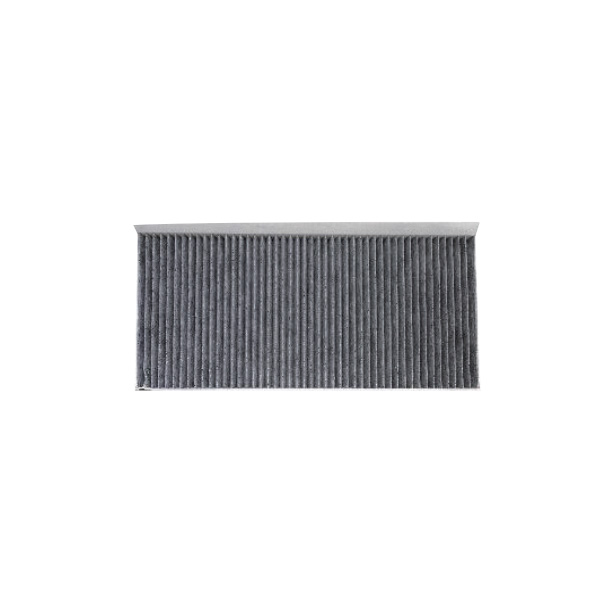
The Thesvin washable activated carbon odor filter is a composite carbon fabric pad that fits into range hoods and integrated stoves to reduce cooking odors and capture coarse particles. It filters airborne grease, dust, hair, and odor-causing gases such as formaldehyde, benzene, and ammonia. It is designed for appliance makers, HVAC suppliers, and aftermarket distributors who need a repeatable, washable filter that matches their existing housing or duct.
Fitment starts with the frame and the sealing surface. The Thesvin filter is built from a polyurethane sponge carrier with activated carbon fixed into the foam structure. That construction gives the pad enough flexibility to compress slightly against a housing lip, which helps it locate without a separate gasket in many range hood and integrated stove designs. Because the material can be die-cut and shaped, the filter follows the outline of the host device rather than forcing the device to adapt to a standard rectangle.
For ducted and recirculating range hoods, the filter sits in the odor-removal stage, usually behind the grease screen. The low airflow resistance of the open-cell foam keeps the fan curve close to the appliance’s original design. The same material can be stamped for air purifier pre-filter layers, fresh-air system pre-filters, car cabin air filter elements, central air handling return grilles, and industrial vacuum cleaners. In each case, the interface is defined by the cut profile, the thickness, and the pore density, not by a fixed catalogue size.
Because the pad is soft and can be cut, it can be supplied as a flat sheet, a die-cut shape, or a framed element. The frame option is defined by the customer’s drawing; the filter material itself is the constant. This is useful when an appliance has a curved or stepped filter slot, or when the filter must wrap around a corner without cracking. The practical result is that the filter can be matched to the housing opening, the retaining ribs, and the service-access direction before performance is discussed.
The filter works on two levels. First, the open-cell foam acts as a primary filter for larger particles such as hair, lint, and visible dust. Second, the activated carbon adsorbs odorous and irritant gases, including formaldehyde (HCHO), benzene, and ammonia. This combination makes it suitable as a pre-filter layer in air purifiers and fresh-air systems, where it protects the main filter while reducing odors.
In kitchen applications, the filter is aimed at cooking odors and volatile organic compounds that pass through the grease screen. It is not a replacement for a grease filter; it is a supplementary odor-control layer. The same logic applies in car cabin air filters and central air return grilles: the pad captures coarse debris and adsorbs gases, while the primary filter handles fine particles. The washable design means the pad can be rinsed with warm water and a neutral detergent to remove surface grease, which helps restore airflow between replacements. Over time, the carbon’s adsorption capacity declines, so the filter is replaced when odor breakthrough becomes noticeable.
| Item | Detail |
|---|---|
| Product name | Washable Activated Carbon Filter (sponge type) |
| Core carrier material | Polyurethane foam sponge |
| Core adsorbent | Powdered or fine granular activated carbon fixed by a special curing process |
| Core filtration performance | Primary filtration of large particles (hair, dust) plus adsorption of formaldehyde (HCHO), benzene, ammonia and other harmful gases |
| Physical structure advantages | Repeatedly washable, very low airflow resistance, high flexibility for easy cutting, excellent air permeability |
| Main application endpoints | Air purifier pre-filter layer, fresh-air ventilation system pre-filter, car cabin air filter, central air conditioning return grille, industrial vacuum cleaner |
| Specification and size customisation | Full OEM/ODM flexibility. Thicknesses such as 3 mm to 50 mm, pore density (PPI) and outer dimensions with die-cut forming |
| Quality certification system | Produced in the company’s 20,000 m² clean workshop; the company holds ISO 9001, ISO 14001 and IATF 16949 certification |
Thesvin’s production system is built around dimensional consistency. The company holds IATF 16949 certification, awarded in 2024, and applies IQC, IPQC, and OQC controls from incoming material through to final inspection. For a die-cut foam filter, that means the cut profile, thickness, and carbon distribution are checked at each stage, so repeated orders match the original fit. The company also operates a CNAS-accredited laboratory that can issue test reports for filtration efficiency, dust holding capacity, and airflow resistance.
Manufacturing takes place in Zhongshan, Guangdong, China, in a 50,000 m² facility that includes six clean workshops totaling 20,000 m². The company holds ISO 9001, ISO 14001, and ISO 45001 certifications, and its products meet REACH and RoHS requirements with supporting compliance documents. With more than 20 years of filter development and export experience to Europe, the United States, Japan, and South Korea, Thesvin has built over 1,000 filter solutions and runs multiple automated production lines with a monthly capacity of several million pieces.
To get an accurate quotation, send us the device or vehicle model, the size or a drawing, the airflow or water flow, the operating conditions, and the quantity you need. If you have an old part, send it or a photo with a ruler in frame; we will work from that. Contact our team to start the fitment review.
Fitment depends on the housing opening and the thickness you can accept. The filter is a flexible polyurethane sponge with activated carbon, so it can be die-cut to your outline and supplied in thicknesses from 3 mm to 50 mm. Send the model and a drawing or photo with dimensions, and we will confirm the cut profile before sampling.
Yes. An old filter or a clear photo with a ruler in frame is enough to start. We measure the outline, thickness, and pore density, then produce a sample to match. If the old part is deformed, include the housing opening dimensions as well.
The composite carbon fabric is designed for adsorption of formaldehyde, benzene, ammonia, and cooking odors, with an initial odor removal efficiency above 85% in our test data. Because performance depends on airflow and contaminant load, we can issue a CNAS laboratory report for your specific application.
Yes, it is washable with warm water and a neutral detergent. Washing restores airflow by removing surface grease, but the carbon’s adsorption capacity declines over time. Under normal household use, we recommend replacement every 6 to 12 months, or sooner if odor breakthrough occurs.
Standard sizes typically start at 1,000 to 3,000 pieces, depending on style and packaging. Custom OEM parts generally start at 5,000 pieces. Regular orders ship in 25 to 35 days; large or custom projects are scheduled after confirmation.
Yes. Standard samples are normally free, with freight paid by the customer. Custom samples are quoted according to the specification, with a sampling time of 7 to 15 days. Each sample can be accompanied by a CNAS laboratory report for performance verification.
The company holds ISO 9001, ISO 14001, and IATF 16949 certifications, and products meet REACH and RoHS requirements. We can provide compliance documents for your market. For specific declarations, tell us the destination country when you inquire.
Send the device or vehicle model, size or drawing, airflow or water flow, operating conditions, and quantity. <a href="/en/contact">Contact us</a> and we will review fitment and reply with a quotation.