
EN

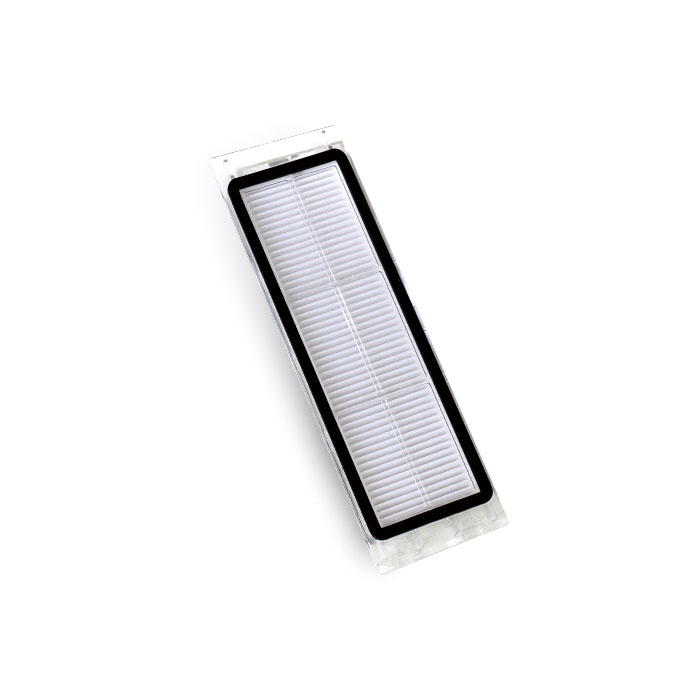
The Thesvin washable dust box filter is an integrated filter assembly designed to fit inside the dust box of robot vacuums, handheld vacuums, mattress cleaners and similar cleaning devices. It captures PM2.5, fine dust, dust mites, pollen and pet dander before air leaves the machine, helping prevent secondary contamination. The filter is made for OEM and ODM customers who need a drop-in replacement that matches their existing housing, airflow path and battery performance.
In cleaning appliances, the filter is only as good as its fit. If the frame is a fraction of a millimetre off, air bypasses the media and dust escapes back into the room. Thesvin therefore treats fitment as the first engineering task, not an afterthought. Each washable dust box filter is built to the customer's dust box dimensions: the outer frame is produced by eco-friendly injection moulding, and the edge can be over-moulded with a rubber seal to close the gap between filter and housing. This edge sealing helps maintain a tight interface without relying on the device's own gasket.
The frame also locates the filter correctly inside the dust box. Because the assembly is integrated (media and frame combined), there is no separate gasket or loose mesh to misalign during cleaning or replacement. The result is a part that seats consistently, is easy to remove for washing, and goes back in the same position every time. For handheld vacuums and mattress cleaners with tighter internal spaces, the frame can be slimmed and the media pleat count adjusted to keep the pressure drop low while still matching the mounting features of the original part.
Fitment is confirmed against a drawing or a physical sample. Thesvin's engineering team reviews the interface points — overall length, width, thickness, corner radii, sealing edge and any locating tabs — before quoting. Where the customer supplies an old part, the team measures it and proposes a matching structure. This approach suits robot vacuum models with integrated dust boxes as well as handheld units where the filter sits directly behind the cyclone.
The filter media is a high-precision PTFE microporous membrane or a composite PP (polypropylene melt-blown) construction, selected for moisture resistance and antibacterial properties. These materials are chosen for cleaning appliances because they resist the damp dust and organic matter often found in household dirt. The media captures PM2.5 particles, fine dust, dust mites, pollen and pet dander, reducing the amount of fine particulate that would otherwise be exhausted back into the room.
The high-porosity, breathable design keeps airflow resistance low. That matters for battery-powered cleaning devices: a restrictive filter forces the motor to work harder, shortening run time and reducing suction at the nozzle. By keeping resistance low, the Thesvin filter helps the device maintain suction and battery endurance while still delivering the filtration needed for a clean exhaust stream. The media is also designed to tolerate regular washing, so the filter can be rinsed and reused rather than replaced after every cleaning cycle.
| Item | Detail |
|---|---|
| Product name | Robot vacuum cleaner / handheld vacuum filter |
| Core filtration material | High-precision PTFE (polytetrafluoroethylene microporous membrane) / composite PP (polypropylene melt-blown) and other moisture-resistant, antibacterial filter media |
| Core filtration function | Strong interception of PM2.5, fine dust, dust mites, pollen and pet dander inside the vacuum; prevents secondary contamination from exhaust air |
| Physical fluid characteristics | High-porosity breathable design with very low operating airflow resistance; does not drain motor suction and supports battery endurance |
| Main end applications | Smart robot vacuums, handheld cordless vacuums, mattress mite removers, car mini vacuums, wet-dry floor cleaners |
| Frame and dimension customisation | 100% customised to the device dust box dimensions; eco-friendly injection-moulded frame, edge over-moulded sealing, and scalable production of washable media (PTFE membrane version) |
| Company certification system | 50,000 m² modern production base and a national CNAS testing centre; ISO 9001, ISO 14001 and IATF 16949 quality management systems |
Thesvin operates under IATF 16949 (achieved in 2024) and ISO 9001, ISO 14001 and ISO 45001 management systems. Dimensional consistency is controlled through incoming inspection (IQC), in-process inspection (IPQC) and outgoing inspection (OQC), so frame dimensions and sealing edges remain stable from batch to batch. The company's own laboratory is CNAS-accredited and can issue test reports for filtration efficiency, dust holding capacity and resistance.
Production takes place in a 50,000 m² facility, which includes six clean workshops totalling 20,000 m². Products comply with REACH and RoHS requirements, and compliance documents can be supplied. With more than 20 years of filtration manufacturing and export experience to Europe, the United States, Japan and South Korea, Thesvin has developed over 1,000 filtration solutions and supports OEM/ODM customisation of size, structure, media grade, frame material, logo and packaging. Multiple automated lines provide monthly capacity in the millions of pieces.
To receive a quote, please share: the device or vehicle model, the filter size or a drawing (or an old part), the airflow or water flow requirement, the operating conditions (humidity, dust load, washing frequency) and the quantity you expect to order. Our engineering team will review fitment and respond with a proposal. Contact us to start the conversation.
The filter is customised to your dust box dimensions, with an injection-moulded frame and optional over-moulded edge sealing to close the gap against the housing. Fitment is confirmed from a drawing or an old part before production. Send us the interface dimensions and we will match the frame and locating features.
Yes. A physical old part is often the fastest way to confirm fitment, because our team can measure the frame, sealing edge and locating points directly. We then propose a matching structure and produce a sample for your approval. If a drawing is available too, it helps speed up the review.
The filter uses high-precision PTFE membrane or composite PP media and is designed to capture PM2.5 and fine dust particles. Thesvin's CNAS-accredited laboratory can test filtration efficiency, resistance and dust holding capacity, and reports are available for each batch. Because efficiency depends on the media grade selected, we confirm the target with you during sampling.
Yes, the PTFE membrane version is designed for washing and reuse, which reduces replacement frequency for end users. The exact washing interval depends on dust load and device design; we recommend confirming it through your own testing. For replacement, the filter can be washed repeatedly before media performance declines, and we can supply media options to match your target service life.
Yes. As an OEM/ODM manufacturer, Thesvin customises dimensions and structure, media grade, frame material and colour, logo printing, packaging (colour box, blister, neutral) and instruction design. With over 1,000 filtration solutions developed, we can adapt the integrated frame to your dust box. Send your requirements and we will propose a specification.
MOQ and lead time depend on the specification and customisation level. Please share your device model, estimated quantity and whether a new mould is needed, and we will confirm both in the quotation. Standard and custom orders are scheduled according to the agreed specification.
Yes. We provide samples for fit and performance evaluation. For custom samples, the sampling period is typically 7–15 days, and the sample fee depends on moulding or customisation requirements. We recommend a full fit test in your device before bulk ordering, and our technical team can support the evaluation.
Dimensional consistency is controlled through IQC, IPQC and OQC at each production stage, under IATF 16949 and ISO 9001 systems. The frame is injection-moulded to the approved drawing, and the CNAS laboratory checks filtration and resistance performance. Each batch can be traced with inspection records. Contact us with your drawing to start the fitment review.