
RU-RU

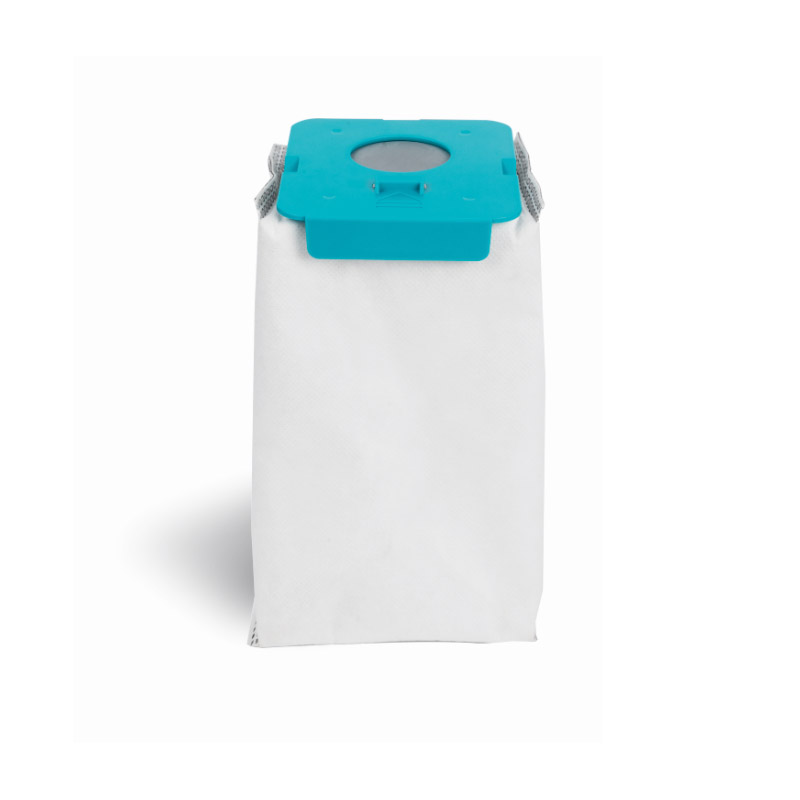
The Thesvin dust collection bag with plastic cover plate is a replacement filter bag designed for automatic dust collection bases of robot vacuums, handheld wireless vacuums and commercial vacuum bins. It captures fine dust (PM2.5), dust mites, pollen and hair, and its plastic cover plate locates and seals the bag in the host device. It is intended for vacuum manufacturers, service centres and distributors seeking a custom-fit bag that maintains suction and prevents secondary exhaust pollution.
Fitment starts with the cover plate. Thesvin manufactures the plastic cover plate to match the docking interface of your dust collection base or vacuum bin. The plate is injection moulded from plastic, and its outline, thickness and port position are tooled to your device dimensions, so the bag seats correctly and the seal closes around the inlet. For devices that use a cardboard collar, we also offer a hard paperboard interface option. The bag itself is a multi-layer composite PP (polypropylene non-woven + melt-blown) construction with an antibacterial filter cotton layer; the flexible material conforms to the base without creasing at the sealing edge.
Handling is part of fitment. A sliding handle and self-sealing design close the bag opening as it is removed, so the user does not touch the collected dust. The closed bag then lifts out of the base without spilling. Because the cover plate is rigid, it also acts as a locating feature: it holds the bag flat against the base wall, keeps the inlet aligned and prevents the bag from collapsing under suction. This is especially useful in robot vacuum bases where airflow reverses during emptying. Thesvin supports OEM customisation of the cover plate structure, colour, logo printing or laser marking, and packaging.
The filter media is a multi-layer composite PP melt-blown material combined with antibacterial filter cotton. This structure captures fine particulate matter at PM2.5 level, as well as dust mites, pollen, hair and other common household allergens. The high-porosity, breathable design keeps airflow resistance low, so the vacuum motor does not lose collection power as the bag fills. The bag also has a high dust-holding capacity, which extends the interval between replacements. For odour-sensitive applications, a composite activated carbon version is available to help reduce smells from the collected dust.
The bag is used in automatic dust collection bases (sometimes called dust stations), handheld wireless vacuums and commercial vacuum bins. In each case, the bag protects the exhaust air path: dust stays inside the bag rather than returning to the room through the exhaust. The self-sealing closure reinforces this by shutting the bag before it leaves the base. Thesvin tests filtration efficiency, dust capacity and strength at its CNAS-accredited laboratory; filtration efficiency for PM2.5-level dust is over 99% according to this product's test data.
| Item | Detail |
|---|---|
| Product name | Dust bag for handheld vacuums / automatic dust collection bag for robot vacuums |
| Core media construction | Multi-layer high-precision composite PP (polypropylene non-woven + melt-blown) / antibacterial filter cotton |
| Filtration function | High-precision capture of fine dust (PM2.5), dust mites, pollen, hair and other household allergens; prevents secondary exhaust pollution |
| Physical and fluid properties | High-porosity breathable design, very low operating airflow resistance, high dust-holding capacity, does not reduce motor suction |
| Main applications | Automatic dust collection bases for smart robot vacuums, handheld wireless vacuums, commercial vacuum bins |
| Size and cover plate customisation | 100% customised to device dimensions. Hard paperboard collar and eco-friendly injection-moulded plastic cover plate designs; sliding self-sealing and activated carbon odour-reduction versions available |
| Company certification | 50,000 m² modern clean production facility and a national CNAS testing centre; company operates under ISO 9001, ISO 14001 and IATF 16949 quality management systems |
If you do not have a drawing, send an original unused bag or the dust base itself; our engineers can reverse-engineer the interface and propose a matching cover plate.
Thesvin operates under IATF 16949 (certified in 2024) and ISO 9001, ISO 14001 and ISO 45001 management systems. Dimensional consistency is controlled through IQC, IPQC and OQC: incoming material inspection, in-process patrol inspection, and outgoing inspection before shipment. The 50,000 m² production facility includes six clean workshops totalling 20,000 m², which help prevent dust and fibre cross-contamination during bag assembly. A CNAS-accredited laboratory tests filtration efficiency, dust capacity, airflow resistance and tensile strength, and batch test reports are kept on file.
Products comply with REACH and RoHS environmental regulations, and compliance documents can be provided. With more than 20 years of filtration product development and manufacturing experience, and ongoing exports to Europe, the United States, Japan and South Korea, Thesvin supports OEM/ODM projects covering size, structure, filter media grade, cover plate material, logo and packaging. More than 1,000 filtration solutions have been developed, and multiple automated production lines support monthly output of millions of pieces. For standard specifications, MOQ is typically 5,000–10,000 pieces; customised products are quoted according to specification complexity. Standard stock orders ship in about 7–15 days; customised orders including tooling typically take 30–45 days, confirmed at order.
To receive a quotation, send us the device or vehicle model, the bag size or interface drawing (or an old part), the airflow requirement, your operating conditions (dust type, temperature, humidity), and the estimated order quantity. Our engineering team in Zhongshan, Guangdong, China, will review fitment and respond with a proposal. Contact us now to start your inquiry.
Fitment depends on the cover plate matching your dust collection base or vacuum bin. Thesvin customises the plastic cover plate to your device dimensions, including outline, port position and sealing method. Send us your device model or interface drawing, and we will confirm compatibility before sampling.
Yes. If you do not have a drawing, you can send an original unused bag or the dust base itself. Our engineers will reverse-engineer the interface and propose a matching cover plate and bag specification.
The multi-layer composite PP media captures PM2.5-level fine dust with over 99% efficiency according to this product's test data. It also intercepts dust mites, pollen and hair, and the self-sealing closure prevents dust from returning to the room.
Yes. We support OEM/ODM customisation of size, cover plate structure (plastic or paperboard), filter media grade including an activated carbon version, cover plate colour, logo printing or laser marking, and retail packaging. More than 1,000 filtration solutions have been developed.
Send your device model, size or drawing, airflow requirement, operating conditions and estimated quantity through our contact page. We will review fitment and provide a sample and quotation. Customised samples are typically developed after interface confirmation.
Standard specifications typically have an MOQ of 5,000–10,000 pieces; customised products are quoted according to specification complexity. Standard stock orders ship in about 7–15 days, while customised orders including tooling usually take 30–45 days, confirmed at order.
Replacement interval depends on dust volume and vacuum usage; the high dust-holding capacity supports longer intervals between changes. We recommend replacing the bag when the base indicates full or when suction noticeably drops. The self-sealing design keeps replacement clean.
Each batch goes through IQC, IPQC and OQC checks for dimensional consistency, and the CNAS-accredited laboratory tests filtration efficiency, dust capacity, airflow resistance and tensile strength. Batch test reports are kept on file. Contact us to discuss your requirements.