
RU-RU

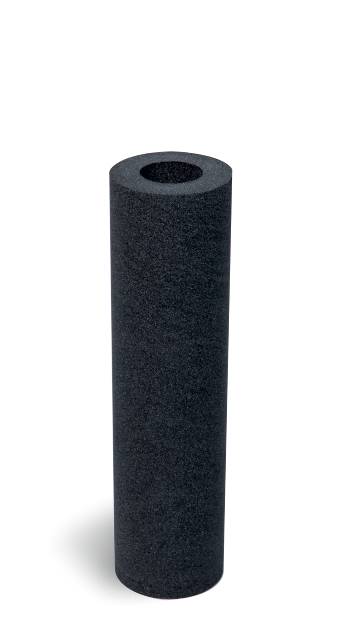
The Thesvin sintered activated carbon rod Ф32×126 is a cylindrical carbon block filter element designed for installation in household water purifiers, refrigerator water dispensers, and commercial coffee machines. It filters chlorine, odours, colour, and certain heavy metals from drinking water, and is intended for appliance manufacturers, water treatment OEMs, and aftermarket replacement suppliers. The rod measures 32 mm in outside diameter and 126 mm in length and is produced by Thesvin in Zhongshan, Guangdong, China.
Fitment is the first consideration for this part because the carbon rod is a drop-in element that must locate positively inside the host housing. The Ф32 mm outside diameter and 126 mm length are standard reference dimensions for compact inline filter cartridges, and the rod is sized to slide into the filter housing without excessive clearance that could cause bypass or vibration. The Thesvin production process allows the outer diameter to be held to the drawing, so the rod seats against the housing wall and the end faces make clean contact with the end caps.
The rod is a rigid sintered body, not a loose granular fill, which means it keeps its shape during installation and does not settle or channel. End caps can be welded to the rod to create the inlet and outlet interface required by the appliance, and the end-cap geometry can be adapted to match the host connector. For equipment where the rod is retained by a central tube or a push-fit collar, the internal bore and end-face flatness are controlled during sintering so that the sealing surfaces remain square to the axis.
Because fitment depends on the housing, Thesvin does not publish a universal mounting position. Instead, the company works from the customer’s drawing, sample, or housing dimensions to confirm the outer diameter, length, end-cap style, and any step or groove required for retention. This approach keeps the carbon rod aligned with the water path and avoids the leaks and bypass that occur when a filter is forced into a mismatched housing.
The filter medium is high-iodine-value coconut shell activated carbon combined with food-grade ion exchange resin. The coconut shell carbon provides a microporous structure with a large adsorption capacity for residual chlorine, chloramine-related taste and odour compounds, and organic matter that affects colour and smell. The ion exchange resin is incorporated into the rod to soften the water and reduce scale formation, and it also assists in capturing lead, mercury, and other harmful heavy metals.
The sintered structure gives the rod a uniform pore network, which supports a high initial flow rate and a filtration accuracy in the 5–10 micrometre range for particulate retention. The carbon is bonded so that the rod does not release black fines into the downstream water, a common problem with loose carbon fills. The combination of carbon adsorption and resin softening makes the rod suitable as a pre-carbon block in reverse osmosis systems, as a post-treatment polishing filter, and as the main filter in direct drinking appliances.
Typical applications include household RO purifiers where the rod serves as a CTO pre-filter or a T33 post-filter, water dispensers, side-by-side refrigerators with built-in water filters, and commercial coffee machines where consistent water quality protects the boiler and the taste of the beverage. The rod is also used in ice machines and other point-of-use appliances that require a compact carbon element.
| Item | Detail |
|---|---|
| Product name | Water purifier and refrigerator carbon block filter (carbon block water filter / CTO filter) |
| Core filtration material | High-iodine-value coconut shell activated carbon with food-grade ion exchange resin |
| Core performance | Softens water and reduces scaling; adsorbs residual chlorine (bleaching powder); removes colour and odour; captures lead, mercury, and other harmful heavy metals |
| Accuracy and service life | Uniform microporous structure, high initial flow, high filtration accuracy, no black fines; large saturation capacity and long service life |
| Standard size reference (outside diameter × length, mm) | Ф60×130 / Ф62×240 / Ф37.5×75 / Ф38×57 / Ф40×195 / Ф51×127 / Ф32×126 / Ф32×106 |
| Main end applications | Household reverse osmosis purifiers (RO pre-filter CTO / post-filter T33), direct drinking machines, side-by-side refrigerator water filters, commercial coffee machines |
| Customisation service | Full OEM/ODM support. Length, diameter, and internal/external diameter ratio can be tooled to the equipment requirement; end-cap welding customisation is available. |
| Quality certification | The company’s 20,000 m² production base is ISO 9001 and IATF 16949 certified. Filter materials meet strict drinking-water safety and hygiene standards and are controlled by a CNAS-accredited testing centre. |
Thesvin operates a 50,000 m² manufacturing facility in Zhongshan, Guangdong, China, including six clean workshops with a combined area of 20,000 m². Carbon rod production runs in a controlled clean environment to prevent cross-contamination, and the plant is certified to ISO 9001, ISO 14001, and ISO 45001. The company obtained IATF 16949 certification in 2024, and its quality system applies IQC, IPQC, and OQC controls across the production flow to keep dimensional consistency from batch to batch.
The on-site laboratory is accredited by CNAS, the China National Accreditation Service for Conformity Assessment, and can issue test reports for filtration efficiency, dust holding capacity, and resistance. These reports support appliance makers who need documented performance data for their own qualification processes. Thesvin has more than 20 years of experience in filtration product development and manufacturing and has supplied export markets in Europe, the United States, Japan, and Korea for over 20 years. Products comply with REACH and RoHS requirements, and compliance documents can be provided. Multiple automated production lines support a monthly capacity of several million pieces.
For OEM and ODM projects, Thesvin customises dimensions, structure, filter media grade, end-cap design, logo, and packaging, and has developed more than 1,000 filtration solutions. Delivery schedules are confirmed per order based on the specification and quantity; standard sizes ship from stock, while custom tooling follows the agreed sample approval timeline.
To receive a quotation for the Ф32×126 carbon rod or a custom size, send the device or vehicle model, the required dimensions or a drawing, the airflow or water flow, the operating conditions (inlet water quality, pressure, temperature), and the order quantity. If no drawing is available, an old part or a clear photo with measurements is sufficient to start the fitment review. Contact Thesvin through the contact page and the engineering team will confirm the specification and reply with pricing and lead time.
It fits appliances whose housing accepts a 32 mm outside diameter rod with a 126 mm length. Because fitment also depends on the end-cap shape and the internal bore, Thesvin checks the housing dimensions or the old part before confirming. Send a drawing or sample and the team will verify the interface.
Yes. An old rod with key dimensions marked, or a clear photo next to a ruler, is enough for the initial fitment review. Thesvin measures the outside diameter, length, bore, and end-cap profile from the sample. A drawing is helpful but not mandatory to start.
The rod combines high-iodine-value coconut shell activated carbon with food-grade ion exchange resin and provides a filtration accuracy in the 5–10 micrometre range for particulate retention. It adsorbs residual chlorine, colour, and odour and reduces lead and mercury. The CNAS-accredited laboratory can issue test reports for filtration efficiency and resistance to support your qualification.
Yes. Thesvin supports OEM and ODM projects and can tool the length, diameter, and internal/external diameter ratio to the equipment requirement, including end-cap welding. Customisation also covers carbon grade, resin content, logo, and packaging. More than 1,000 filtration solutions have been developed, so a custom fit is a standard part of the service.
Standard sizes typically have an MOQ of 1,000–2,000 pieces, while custom sizes are recommended from 5,000 pieces, depending on specification and packaging. Samples are produced against the confirmed dimensions for fit and flow testing before an order is placed, and standard items ship in 7–15 days. Custom production lead time is generally 25–35 days after sample approval.
Under normal municipal water conditions (TDS below 500 ppm and residual chlorine below 2 ppm), the recommended replacement interval is 6–12 months or approximately 2,000–4,000 litres of treated water, depending on water quality and flow. For commercial coffee machines and ice makers with high daily use, replacement should follow the actual treated volume. Thesvin can provide life-test guidance for specific market conditions.
No. The sintered structure bonds the carbon particles into a rigid rod, so the element does not release black fines downstream, which is a common issue with loose carbon fills. The uniform microporous structure also supports a high initial flow rate. Each batch is controlled through IQC, IPQC, and OQC to maintain dimensional and structural consistency.