
RU-RU

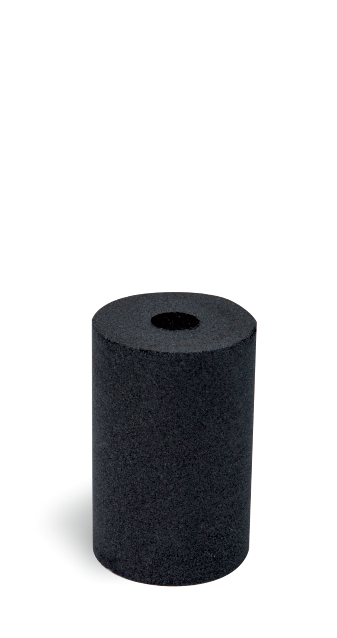
The Thesvin sintered activated carbon rod water filter Ф38×57 is a cylindrical carbon block that installs in the filter housing of residential reverse osmosis systems, refrigerators, water dispensers and commercial coffee machines. It reduces chlorine, odours, colour, VOCs and heavy metals such as lead and mercury, while an integrated food-grade ion exchange resin helps soften the water and inhibit scale. The Ф38 mm outside diameter and 57 mm length make it a direct-fit replacement for compact inline filter positions, and the rod is aimed at appliance makers, water treatment OEMs and aftermarket distributors who need a repeatable, dimensionally stable carbon block. Thesvin manufactures the rod at its facility in Zhongshan, Guangdong, China.
Fitment starts with the two dimensions that the housing controls: outside diameter and overall length. The Ф38×57 rod is nominally 38 mm in diameter and 57 mm long. In practice, the part locates on its cylindrical outer surface inside the filter housing or cartridge sleeve, and the end faces seat against the housing’s internal end stops. Because the rod is a rigid sintered body, it holds its shape under the compression of the housing cap and does not deform into the bypass path the way a loose granular fill can. That dimensional stability is what keeps the seal at the end faces predictable from one replacement to the next.
Thesvin supports full OEM/ODM customisation of the rod, including length, diameter and the ratio between inner and outer diameter, with tooling made to the host device’s requirements. End-cap welding options are also available when the application calls for a bonded interface rather than a plain cut end. If you are designing a new housing, send the cavity drawing and the intended flow direction; if you are replacing an existing part, send the old rod or its measured dimensions, and Thesvin will match the interface before discussing performance.
The filtration medium is a high-iodine-value coconut shell activated carbon combined with food-grade ion exchange resin. The carbon’s microporous structure gives a high initial flow rate and a large adsorption capacity for chlorine (bleaching powder), off-tastes and odours, colour bodies and organic pollutants such as VOCs. The ion exchange resin works alongside the carbon to soften the water and reduce scale formation, and the block also intercepts harmful heavy metals including lead and mercury. Because the carbon is sintered rather than merely packed, the block does not shed black carbon fines downstream, which matters in drinking-water and beverage equipment where a fine particle can end up in the cup.
The uniform pore structure supports a high filtration accuracy, and the rod is commonly used as a pre-filter (CTO stage) or post-filter (T33 stage) in household RO systems, in direct-drinking dispensers, in the built-in water filters of side-by-side refrigerators, and in commercial coffee machines. It is a water filter, not a sterilising device; its role is adsorption, softening and particle retention ahead of, or behind, the RO membrane.
| Item | Detail |
|---|---|
| Product name | Carbon block water filter for water purifiers and refrigerators (CTO filter) |
| Core filtration material | High-iodine coconut shell activated carbon plus food-grade ion exchange resin |
| Core performance | Softens water and inhibits scale; adsorbs chlorine (bleaching powder), off-colour and odour; intercepts harmful heavy metals such as lead and mercury |
| Accuracy and service life | Uniform microporous structure, high initial flow, high filtration accuracy, no black carbon fines; large saturated adsorption capacity and long service life |
| Standard size reference (OD × length, mm) | Ф60×130 / Ф62×240 / Ф37.5×75 / Ф38×57 / Ф40×195 / Ф51×127 / Ф32×126 / Ф32×106 |
| Main end applications | Household RO purifiers (pre CTO / post T33), direct-drinking dispensers, built-in filters of side-by-side refrigerators, commercial coffee machines |
| Customisation | OEM/ODM supported: length, diameter and ID/OD ratio made to device requirements with tooling; end-cap welding available |
| Quality certification | Production base certified to ISO 9001 and IATF 16949; filter media meet strict drinking-water safety and hygiene standards; CNAS-recognised testing centre for quality control |
Thesvin’s production base is certified to IATF 16949 (obtained in 2024) and runs IQC, IPQC and OQC controls through the process, which is how dimensional consistency is held batch to batch on a sintered part. The self-built laboratory is CNAS-accredited and can issue test reports covering filtration efficiency, dust holding capacity and resistance. The plant covers 50,000 m², including six clean workshops totalling 20,000 m², and the company holds ISO 9001, ISO 14001 and ISO 45001 certification. Products meet REACH and RoHS requirements, and compliance documents can be supplied. With more than 20 years of filtration development and manufacturing experience and more than 20 years of continuous export to Europe, the United States, Japan and Korea, Thesvin has developed over 1,000 filtration solutions and supports OEM/ODM customisation of size, structure, media grade, end caps, logo and packaging. Multiple automated production lines support monthly output in the millions of pieces.
To get a quotation and a fitment check, send us the device or vehicle model, the rod size or a drawing, the required airflow or water flow, the operating conditions (inlet chlorine, pressure, temperature) and the quantity you expect to order. If a drawing is not available, an old part with its measured dimensions works just as well. Contact us through /en/contact and our team in Zhongshan, Guangdong, China will respond with the next step.
It fits if your housing accepts a nominal 38 mm outside diameter and 57 mm length, with the end faces seating against the housing’s internal stops. Because the sintered body is rigid, it holds those dimensions under cap compression. Send the cavity drawing or the old part’s measurements and Thesvin will confirm the interface before you order.
Yes. An old rod with its outside diameter, inside diameter and length measured is enough to start a fitment check. A photo of the part next to a ruler also helps. If no part is available, a sketch of the housing cavity with the same dimensions works as well.
The high-iodine coconut shell carbon and food-grade ion exchange resin reduce chlorine, odours, colour, VOCs and heavy metals such as lead and mercury, and the resin helps soften the water and inhibit scale. The block has a uniform microporous structure and does not shed black carbon fines. For a specific duty point, share your flow rate and inlet chlorine level so the grade can be matched.
Yes. Thesvin supports OEM/ODM customisation of length, diameter and the inner-to-outer diameter ratio, with tooling made to the host device, and end-cap welding is available. The Ф38×57 is one standard size among references from Ф32 to Ф62. Send your drawing and target flow rate to start the review.
For standard carbon rod sizes the MOQ is usually 1,000–2,000 pieces, depending on size and packaging; custom moulded sizes are suggested from 5,000 pieces. Standard stock ships in about 7–15 days, while OEM production runs typically take 25–35 days. Confirm the quantity and packaging scope with the quotation.
Yes. For standard sizes, 3–5 samples can be provided free of charge with freight collect; custom sizes carry a sampling fee that is refundable against mass production. Sampling usually takes 7–10 working days. CNAS laboratory test reports can be supplied with the samples to support your own approval process.
Under standard conditions (inlet chlorine ≤2 ppm, flow 1 L/min), the Ф38×57 rod has an effective life of about 3,000–6,000 litres or 6–12 months, depending on actual water quality and usage. Store unopened packs in a cool, dry, ventilated place away from sunlight and odours; shelf life is 2 years. Replacement instructions are included in the packaging and technical documents.